








Key Takeaways
- Onboarding starts before day 1: A good onboarding checklist begins with preboarding, covers the first day of work, and accompanies new employees through to the end of their probation period.
- HR needs more than formalities today: Alongside the contract, personnel file, and team integration, a clean process now also includes the Evidence Act (Nachweisgesetz), GDPR, access permissions, and – where relevant – AI training.
- The biggest weak point is often between HR and IT: When the laptop, email, software, and access aren't ready in time, the employee experience suffers within the first few hours – and HR loses valuable time.
- deeploi closes exactly this gap: As an all-in-one solution for SMBs, deeploi is the ideal choice for standardised, secure, and fast onboarding – because HR processes and IT provisioning work seamlessly together.
The reality in many SMBs is straightforward: HR organises contracts, checklists, and appointments – but new employees still sit on day one without a working laptop, without an email account, or without the right access. This is exactly where a structured onboarding checklist for new employees in HR proves its worth. It doesn't just create a welcoming start – it also protects against compliance gaps, unnecessary back-and-forth, and avoidable IT chaos.
The challenge grows when HR or office management has to handle IT tasks on the side. In that case, a generic template simply isn't enough. You need a process that brings together administrative requirements, data protection, team integration, and IT provisioning.
Why a structured onboarding checklist matters
A good onboarding checklist doesn't just reduce stress – it also reduces real costs. Poor onboarding isn't a soft HR issue; it's an operational risk. When expectations are unclear, access is missing, or responsibilities aren't defined, new employees quickly lose confidence in their employer. At the same time, HR ends up chasing people by phone, working from improvised spreadsheets, and coordinating last-minute with managers or external service providers.
- €33,000 – the average cost of turnover per case, showing how expensive early attrition can be.
- With 20 hires per year and 25% early attrition, you're looking at around €165,000 in avoidable costs.
- Manual IT onboarding typically takes 2–3 hours per person when accounts, software, and devices have to be set up individually.
The most common weak point is the gap between HR and IT. Everything is set up in the HR system – but operational execution is still missing. That's exactly why your checklist shouldn't just collect to-dos: it needs to define clear ownership, deadlines, and handovers. If you're also looking for a practical template, this onboarding checklist is a useful companion.
Legal requirements during onboarding that HR needs to know right now
Onboarding is also a compliance process. In HR, it's not enough to think only about the contract, the welcome, and the equipment. You should factor in current requirements from the German Evidence Act (Nachweisgesetz), data protection law, and – where applicable – AI regulation.
Since 1 January 2025, key employment conditions can in many cases be communicated in text form – for example, by email with a PDF attachment. This simplifies processes considerably, but it doesn't replace the written form requirement in every situation.
Key deadlines and special cases
It's particularly important to note that certain information must be provided on the very first day of work, with further documentation required within 7 calendar days at the latest. At the same time, there are exceptions: fixed-term contracts continue to require written form, as do certain non-compete clauses. Terminations and termination agreements also cannot simply be replaced by digital communication.
You should also approach onboarding with a data protection lens. Who processes which personal data, who gets access, and which documents need to be countersigned separately? These are exactly the questions that get overlooked in many checklists.
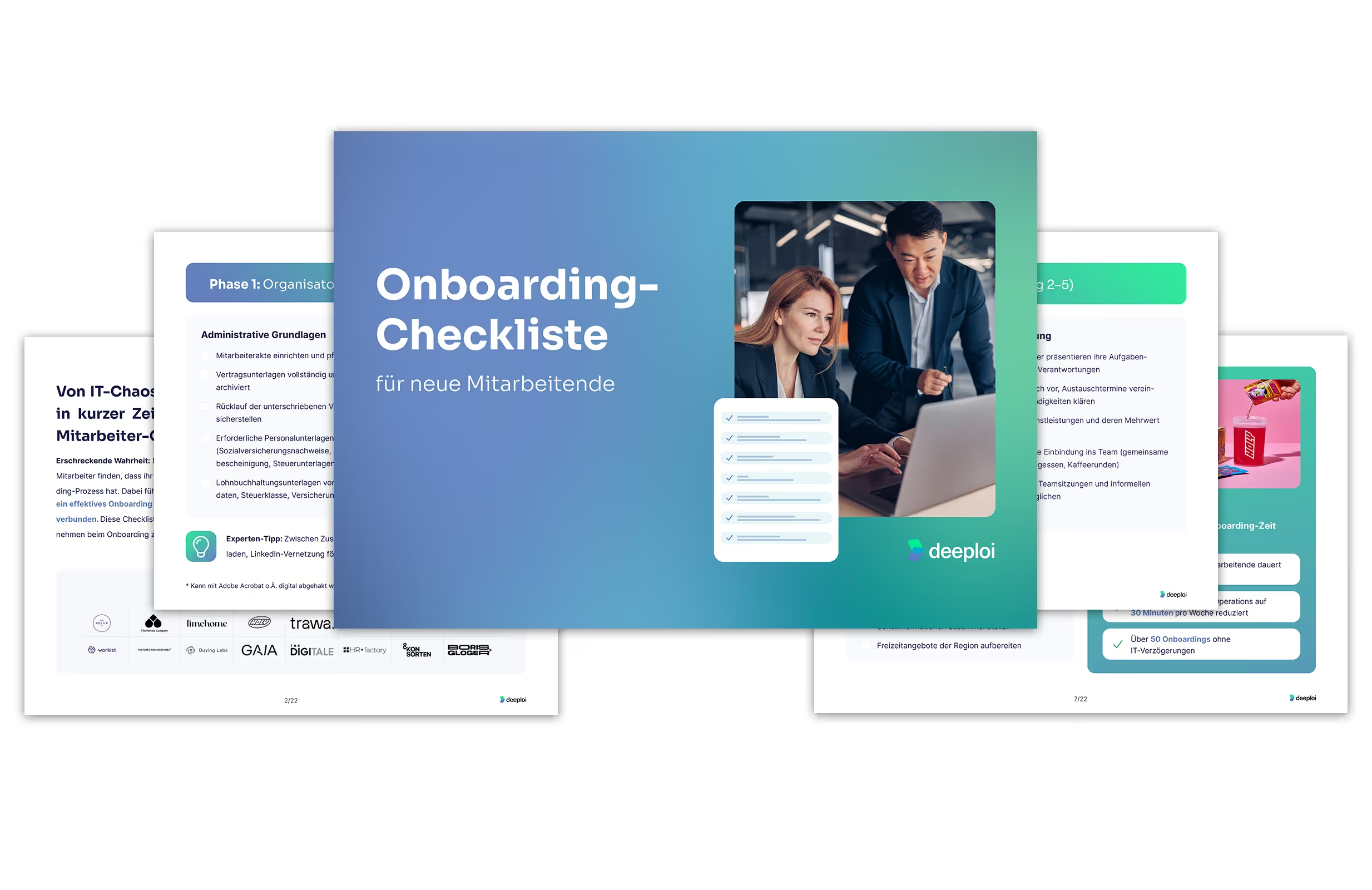
The 5 phases of a good onboarding checklist for new employees in HR
Even the best checklist falls short if it only covers the first day of work. In practice, onboarding works well when you break the process into clear phases and assign ownership to each one.
1. Preboarding
- Send the contract and mandatory documents
- Set up the personnel file
- Confirm start date, role, and team
- Assign a buddy or dedicated point of contact
- Submit IT requirements and access permissions
2. First day
- Organise the welcome, agenda, and team introduction
- Check that equipment, access, and communication channels are ready
- Explain key policies, data protection rules, and security guidelines
3. First week
- Structure the role-specific onboarding
- Set up recurring check-ins with the line manager and buddy
- Resolve any outstanding access issues, missing permissions, or open questions
4. First month
- Conduct a feedback conversation
- Clarify goals and expectations
- Reflect on team collaboration
5. Through to the end of the probation period
- Establish a 30-60-90-day framework or probation period check-ins
- Assess development, productivity, and cultural integration
- Feed learnings from each onboarding into process improvements
Once you standardise this structure, onboarding becomes predictable, repeatable, and far less error-prone.
IT onboarding is often the real bottleneck for HR
Many HR teams have their administrative workflows well under control – but struggle with operational IT provisioning. That's where the frustration sets in. New employees don't just need documents; from minute one, they need working devices, email access, and role-specific software. In SMBs without a dedicated IT department, this task often lands with People Ops, office management, or whoever happens to handle IT on the side.
This is exactly where an all-in-one solution like deeploi for automated onboarding makes a difference. As soon as a new hire is triggered via an HR system such as Personio, access, email accounts, and software can be automatically provisioned based on predefined role packages. This reduces onboarding effort from 2–3 hours down to 3–5 minutes. For remote teams, devices arrive ready to use via zero-touch provisioning. If you want to go deeper on the technical foundation, device management, software license management, and patch management are all important building blocks.
Data protection checklist for onboarding in HR
Data protection is often treated as an afterthought in onboarding – even though new employees can be working with personal data from day one. A solid HR checklist should therefore not just collect documents, but also cover technical and organisational measures properly.
- Confidentiality commitment: New employees should receive separate instruction on handling personal data with care.
- Access on a need-to-know basis: Permissions should only be granted for the data and systems genuinely required for the role.
- IT usage policy: Rules on passwords, devices, removable media, and secure behaviour should be handed over early.
- Device security: Encryption, policies, and centralised management should be built in from the start.
- Documentation: HR should be able to track which documents were handed over and which access rights were activated.
For growing teams in particular, a centralized solution for devices and security policies is worth the investment. A properly configured device management system helps enforce standards across Windows, macOS, and iOS devices. If you want to read further, this MDM software comparison is also a useful resource. With deeploi, devices can be managed centrally, policies enforced, and lost devices secured via remote lock or wipe – taking pressure off HR and reducing security risks.
Remote and hybrid onboarding requires especially clear processes
With distributed teams, weak processes become visible even faster. When new employees start remotely, you can't just solve missing access or open questions at the desk next door. Remote onboarding therefore requires an even more precise checklist than a standard office start.
- Pre-start communication: Send the agenda, contact persons, and initial information well before the start date.
- Device provisioning: Laptop and accessories should arrive ready to use before day one.
- Virtual onboarding sessions: Plan dedicated sessions for team introductions, tool walkthroughs, role clarification, and Q&A.
- Social integration: A buddy system, short getting-to-know-you calls, and regular check-ins prevent isolation.
- Technical support: Especially in remote settings, fast help determines whether someone can actually work productively.
With deeploi, devices can be shipped directly to employees and delivered pre-configured via zero-touch provisioning. Combined with automated role packages and an average support response time of 12 minutes, the start becomes significantly more reliable. For additional orientation, the detailed onboarding checklist is also worth a look.
Common onboarding mistakes – and how to avoid them
Many onboarding problems aren't one-off incidents – they're recurring patterns. Once you know them, you can improve your process quickly.
Mistake 1: Onboarding is reduced to the first day of work. Solution: Work with clear phases from preboarding through to the end of the probation period.
Mistake 2: HR and IT work in silos. Solution: Define which HR trigger automatically initiates which IT task.
Mistake 3: Every role receives the same standard setup. Solution: Define role-based software packages for HR, Sales, Marketing, and Finance.
Mistake 4: Data protection and access permissions are checked too late. Solution: Link access rights directly to role and the need-to-know principle.
Mistake 5: Offboarding isn't considered. Solution: Everything granted at the start should be cleanly revoked when someone leaves.
This is exactly why an all-in-one solution is often more practical than scattered individual tools. When the HR process, device management, software provisioning, and support all work together, onboarding becomes not just faster – but also more secure and consistent.
Conclusion
A good onboarding checklist for new employees in HR brings together compliance, structure, employee experience, and IT provisioning. Thinking only about contracts and welcome packs isn't enough. What matters is that new team members are ready to work from day one, receive the right permissions, and can find their feet both professionally and culturally.
For SMBs without a large IT department in particular, deeploi is a strong recommendation here. The platform combines HR-adjacent processes with automated onboarding, centralised device management, software deployment, patch management, and human support – reducing IT effort by up to 95% and creating a significantly more reliable start for new employees.
FAQ
What should an onboarding checklist for HR include as a minimum?
At a minimum, it should cover preboarding tasks, contracts and mandatory documents, responsibilities, data protection items, IT requirements, team integration, and feedback sessions through to the end of the probation period. A good checklist doesn't just cover day one – it covers the entire onboarding journey.
Which documents should new employees have on their first day?
The most important items are the key employment conditions, information on compensation and working hours, and all documents needed for the start. You should also prepare data protection and IT policies so that new employees know how to handle data, passwords, and systems from day one.
How does onboarding work if we don't have an in-house IT department?
In that case, HR needs a particularly clear process with defined handovers and as much automation as possible. With deeploi, access, software, and devices can be provisioned automatically for new employees – instead of coordinating everything manually by ticket or email.
Is a digital employment contract always an option now?
Not in every case. While many notifications have been possible in text form since 2025, stricter formal requirements still apply to certain situations – such as fixed-term contracts. Special cases should always be reviewed separately.
What's the best place to start if our onboarding is still unstructured today?
Start with a simple phase logic: preboarding, first day, first week, first month, and probation period. Then define ownership per phase for HR, the line manager, and IT. If you find that the IT side is regularly creating delays, deeploi is a sensible next step to set up the process centrally and efficiently.

.jpg)
.png)