





Key Takeaways
- MDM is essential infrastructure. With 73% of remote employees using personal devices for work, unmanaged endpoints are one of the biggest security risks for growing companies.
- Evaluate MDM on four pillars. OS compatibility, scalability, integration depth, and total cost of ownership matter more than feature lists when choosing the right solution.
- The biggest pitfalls happen after selection. Underestimating rollout complexity, over-restricting devices, and ignoring the end-user experience are the mistakes that derail most MDM implementations.
- Standalone MDM only solves part of the problem. Device management creates the most value when it connects directly to onboarding, offboarding, HR systems, and IT support rather than operating in a silo.
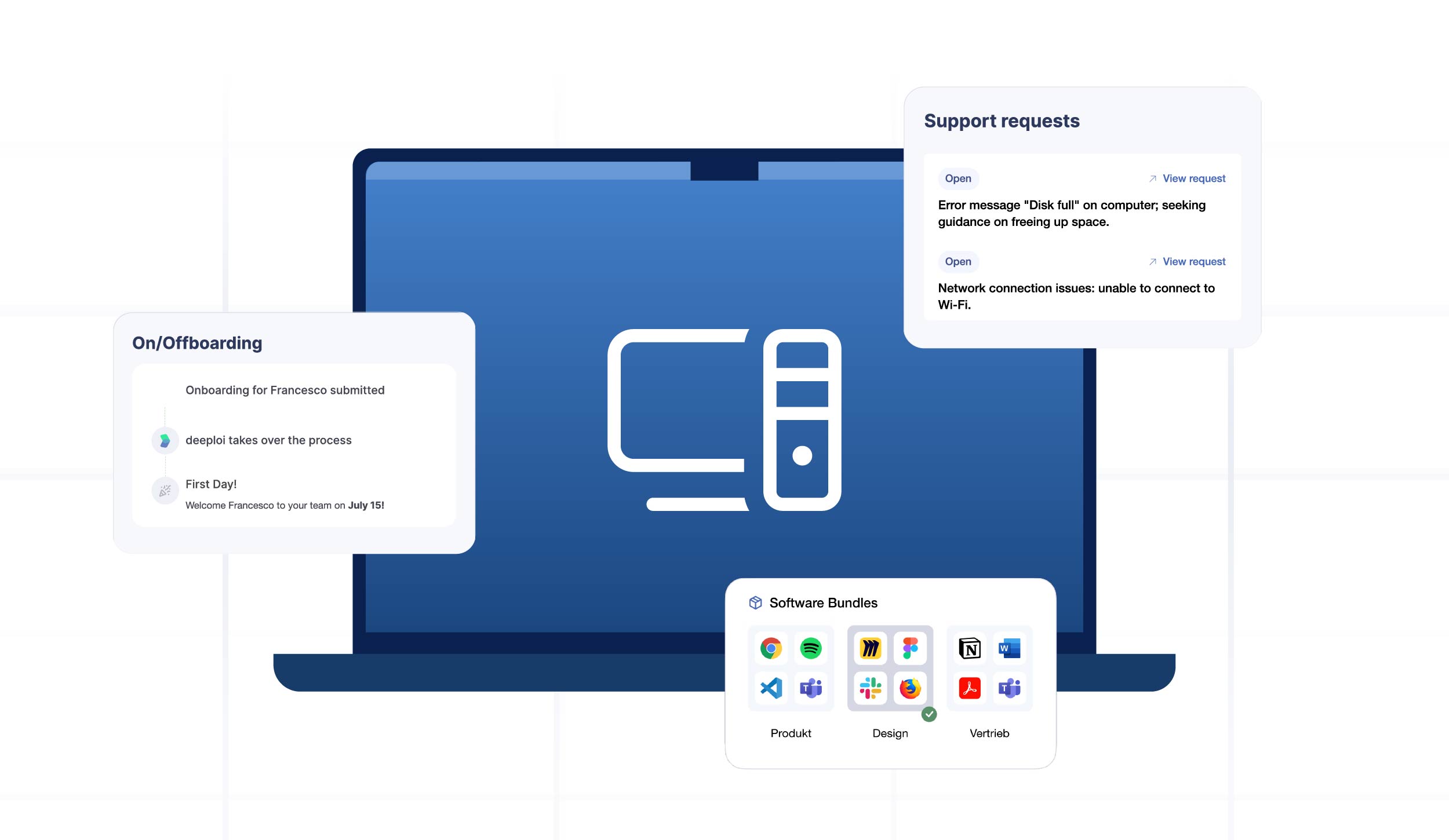
- deeploi embeds MDM into a complete IT platform. With zero-touch provisioning, automated policy enforcement, and a 12-minute average support response time, deeploi makes device management accessible for SMBs without dedicated IT staff.
What Is MDM and Why Does It Matter for Modern IT Teams?
Managing a growing fleet of laptops, tablets, and smartphones across distributed teams has become one of the most pressing challenges in modern IT. Mobile Device Management, commonly known as MDM, is the practice of centrally securing, configuring, and monitoring every endpoint that connects to your company's network. For organizations navigating hybrid and remote work, choosing the right MDM software solution is no longer optional. It's business-critical infrastructure.
The numbers paint a clear picture. (Chanty) reports that 73% of remote employees admit using personal devices for work purposes, a habit that dramatically increases exposure to phishing, ransomware, and data leaks. Without a structured approach to device management, companies leave themselves exposed to threats they could easily prevent.
MDM has evolved well beyond simple device tracking. Today's platforms serve as the backbone of endpoint security, enabling IT teams to enforce compliance policies, distribute software, and respond to incidents in real time. Whether you're a 20-person startup or a 500-employee mid-market company, understanding what MDM can do, and what to look for, is the first step toward building resilient IT operations.
Platforms like deeploi go a step further by embedding MDM into a broader all-in-one IT management platform, so device management doesn't exist in a silo – it connects directly to onboarding, offboarding, security, and support.
Key Capabilities Every MDM Solution Should Offer
Before comparing vendors, you need a clear picture of the core features that define a strong MDM platform. Here's what should be on your checklist:
- Remote wipe and lock: The ability to erase or lock a lost or stolen device instantly, protecting sensitive data from unauthorized access.
- Policy enforcement: Centralized rules that govern password complexity, encryption standards, and network access across all enrolled devices.
- OS update management: Automated patching and update schedules that keep devices secure without relying on individual users.
- App distribution: Push approved applications to devices silently, ensuring employees have the tools they need from day one.
- Zero-touch enrollment: New devices configure themselves automatically when powered on, eliminating manual setup entirely. As part of its all-in-one IT platform, deeploi's zero-touch provisioning takes this further – devices arrive preconfigured and ready to use from the first startup, with all required apps, security policies, and workspace accounts already in place.
These capabilities form the foundation. There are compelling reasons why companies adopt MDM systems, and each of these features addresses a real operational pain point that grows more acute as your device fleet expands.
How Should You Evaluate and Compare MDM Solutions?
With dozens of MDM vendors competing for attention, a structured evaluation framework saves time and prevents costly mistakes. The goal isn't to find the platform with the longest feature list. It's to find the one that fits your environment, your team, and your growth trajectory.
Start with these four pillars:
- OS compatibility: Does the solution support macOS, Windows, iOS, Android, and Linux? Many platforms excel on one or two operating systems but fall short on others.
- Scalability: Can the platform handle 50 devices today and 500 next year without performance degradation or architectural overhauls?
- Integration ecosystem: How well does it connect with your existing tools, including identity providers, HR systems, ticketing platforms, and security solutions?
- Total cost of ownership: Look beyond the per-device license fee. Factor in implementation costs, training requirements, and ongoing administrative overhead.
For SMBs in particular, integration depth matters more than feature count. deeploi, for example, connects directly to HR systems like Personio, BambooHR, and HiBob, so device enrollment and deprovisioning trigger automatically from HR workflows – no manual handoffs required.
An often-overlooked data point: (AppTec360) found that 86% of companies report that MDM improves the efficiency of managing their employees' devices. That efficiency gain, however, only materializes when the solution genuinely fits your infrastructure.
Matching MDM to Your IT Environment
Not every MDM platform suits every organization. The right choice depends on several contextual factors that are unique to your business.
Company size matters. A 30-person startup likely needs a lightweight, self-service platform. A 300-person company with multiple offices may need advanced automation and role-based administration. Consider how automated device management delivers ROI at different scales.
Device ownership model matters. If your company issues corporate-owned hardware, you'll want full device control. If you operate a BYOD (Bring Your Own Device) policy, you need containerization features that separate work data from personal data without overstepping privacy boundaries.
Your existing tool stack matters. An MDM solution that doesn't integrate with your identity provider or onboarding workflows creates silos. The best platforms connect seamlessly to the tools your team already uses, from Google Workspace or Microsoft 365 to HR and ticketing systems. Platforms like deeploi's centralized device management are designed specifically to bridge these gaps for SMEs.
What Are the Most Common MDM Pitfalls, and How Do You Avoid Them?
Selecting an MDM solution is only half the battle. Many organizations stumble during implementation and ongoing management. Here are the pitfalls that trip up IT teams most frequently.
Underestimating rollout complexity. Enrolling hundreds of devices sounds simple in theory. In practice, legacy devices, inconsistent OS versions, and employee resistance create friction. Plan for a phased rollout with clear communication at every step.
Ignoring the end-user experience. If your MDM policies make devices slow, restrict useful apps, or create constant login prompts, employees will find workarounds. Shadow IT thrives when official tools frustrate users. A good MDM strikes a balance between security and usability.
Over-restricting devices. Locking down every feature might seem safe, but excessive restrictions reduce productivity and morale. Tailor policies to actual risk levels rather than applying blanket rules across the board.
Neglecting license management. MDM licenses, app licenses, and OS licenses all need tracking. Without proper oversight, you'll overspend on unused seats or, worse, lose compliance visibility.
The consequences of these mistakes are measurable. Approximately 48% of organizations have reported suffering a data breach linked to an unsecured or unmanaged personal device (Sci-Tech Today). Meanwhile, 63% of enterprises report difficulty enforcing consistent security controls across diverse operating systems and device types (Electroiq).
The underlying issue is that managing MDM is inherently complex, time-consuming, and deeply technical. This is exactly the problem deeploi was built to solve. As an all-in-one IT platform combining automation with personal expert support, deeploi makes MDM accessible even for teams without dedicated IT staff. With a 12-minute average support response time and automated policy enforcement across macOS, Windows, iOS, and Android, it removes the technical barriers that lead to poor implementation and security gaps.
Frequently Asked Questions
How Long Does a Typical MDM Rollout Take?
For most MDM solutions, a small fleet of 50 to 100 devices requires a well-planned rollout of four to six weeks. Larger deployments with 500 or more devices, multiple OS types, and legacy hardware may take several months. The biggest variables are device diversity, existing IT documentation, and how much pre-enrollment preparation is needed.
With deeploi, implementation is significantly faster. Workspace integration and HR system connection takes a few minutes, and full platform rollout typically completes within a few days to two to three weeks – with no disruption to ongoing operations. Most importantly, the entire process requires minimal effort and no IT expertise.
What Happens If an Employee Leaves the Company?
MDM platforms allow IT teams to remotely revoke access, remove corporate data, and unenroll the device instantly. For company-owned hardware, a full device wipe restores it to factory settings. This ensures clean offboarding without manual intervention.
Is MDM Only for Large Enterprises?
Not at all. Small and mid-sized companies often benefit the most from MDM because they lack the large IT teams needed to manage devices manually. Automation handles the heavy lifting, and over 53% of organizations experienced a mobile-related security incident resulting in data loss or downtime during 2024, making MDM essential regardless of company size.
deeploi is purpose-built for this segment: over 200 SMBs across Europe already use the platform to manage their entire device fleet without needing an internal IT department.
How Does MDM Handle Security Compliance?
MDM platforms enforce security baselines automatically, including encryption requirements, password policies, firewall rules, and OS patch levels. Many solutions also generate compliance reports, making it easier to demonstrate adherence to frameworks like ISO 27001 or SOC 2 during audits.
What Should I Budget for an MDM Solution?
Pricing varies widely. Per-device licensing typically ranges from three to ten euros per month, depending on features and OS coverage. However, the total cost of ownership includes implementation, training, and ongoing management time. Platforms that automate enrollment and policy management significantly reduce long-term costs.
Choosing MDM That Grows With You
Selecting the right MDM solution is a strategic decision that impacts security, productivity, and employee satisfaction. The best choice balances robust security controls with a frictionless user experience, scales with your business, and integrates cleanly into your existing workflows.
Avoid the common traps: don't over-restrict, don't underestimate rollout complexity, and don't ignore total cost of ownership. Evaluate platforms against your specific environment, not against feature comparison charts alone. With thoughtful selection and careful implementation, MDM transforms from a technical headache into a competitive advantage that protects your data and empowers your team.