





Key Takeaways
- IT outsourcing means handing IT tasks over to an external provider. Loss of control and unpredictable costs can result from outdated, manual structures.
- Three models compared: the reactive IT service company billed by the hour, the proactive MSP at a flat rate, and the outsourced IT department that automates processes.
- The right choice depends on your size: under 10 employees, a local provider is enough; between 10 and 30, it comes down to how much internal IT knowledge you have; above 30 without an internal IT team, an outsourced IT department makes sense.
- deeploi automates your IT completely and effortlessly: onboarding, device management, support, and compliance on a single platform. Ideal for growing SMBs with 30 to 300+ employees, priced predictably per user, and scalable, even without an internal IT department.
You're actually an HR manager, an office manager, or a founder. And yet you're the one responsible for IT at your company. It landed on your plate because nobody else was taking care of it. Now the team is growing, the problems are piling up, and you're wondering: should I bring in an IT outsourcing provider, and if so, which one? Traditional IT service providers often only solve half the problem. This article shows what's actually needed instead, and why deeploi is the most sensible choice for many growing SMBs.
What IT outsourcing really means, and what most providers get wrong
IT outsourcing simply means: IT tasks aren't handled in-house but handed over to external providers. Sounds simple enough. In practice, though, many SMBs associate it with three specific worries:
- Loss of control: when external providers take over IT, you often no longer know what's happening, what's been changed, or who has access to what.
- Unpredictable costs: hourly rates and project billing make it hard to forecast IT spending. Every ticket becomes a black box.
- Dependency: once you're with a provider, it's hard to get out. Missing documentation and proprietary systems make switching expensive and time-consuming.
These concerns aren't unfounded – they come from real experience with traditional, outdated models. But the problem isn't IT outsourcing as a concept, it's the model behind it. Anyone who ends up with the wrong provider and the wrong structure experiences exactly what they feared.
Choose the right model, and you get the opposite: full transparency, predictable costs, and IT that thinks ahead.
{{cta}}
IT outsourcing models: IT service company, MSP, or outsourced IT department?
Not every IT outsourcing provider works the same way. The differences are structural, and they determine whether the model grows with your company or eventually holds it back.
The IT service company shows up when something's broken. It's reactive and bills by the hour. The MSP goes a step further: flat rate, SLA, proactive monitoring. But even with an MSP, a lot still happens manually: onboarding, offboarding, and device management run through tickets and coordination effort. A modern, outsourced IT department automates exactly these processes: IT runs in the background, predictably and scalably, without anyone internal having to coordinate it.
What a modern IT outsourcing provider delivers in practice (using deeploi as an example)
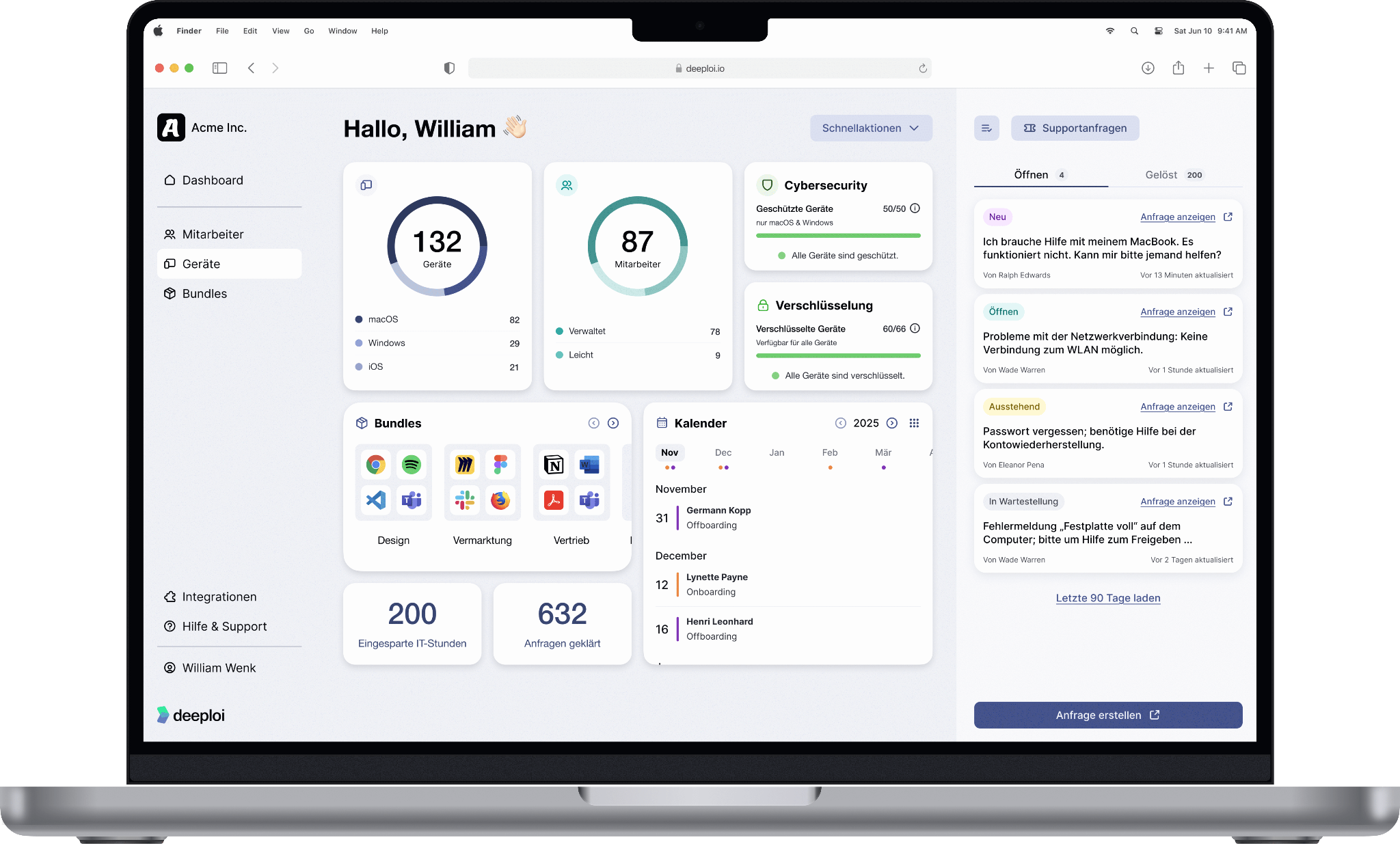
deeploi works like an outsourced IT department: the platform takes over day-to-day IT operations without you having to hire anyone for it. Using deeploi as an example, here's what that looks like in practice:
- Automatic onboarding and offboarding: new employees automatically receive all accounts, devices, and software, triggered by the connection to HR systems like Personio, FactorialHR, or HiBob. No manual ticket, no waiting. When someone leaves, access is revoked, data is secured, and devices are reset, without a manual ticket or long wait times.
- Device management in the background: patch management, software distribution, and device configuration run automatically. Devices are always up to date and meet current security requirements.
- IT support in German and English: for questions that aren't resolved automatically, a helpdesk is available. At deeploi, the average response time is 12 minutes (SLA is 30 minutes).
- Security and compliance as standard: encryption, access controls, and security policies are built into the platform. ISO 27001 certification isn't a paid add-on, it's part of the core offering.
- One platform instead of many providers: devices, accounts, software, support, and security come together centrally, instead of being spread across many tools and providers.
Two examples show what this means in practice: Instaffo cut IT costs by 75 percent and reduced manual IT workload by 97 percent. ease shortened onboarding times from up to two hours to five minutes. Similar results show up across all companies that have chosen deeploi as their IT solution.
{{quote}}
Which IT outsourcing solution fits your company?
An honest breakdown to help you find the right IT model for your company:
deeploi also doesn't depend on whether someone on the team currently manages to keep IT more or less under control. If that person leaves, the company grows, or the structure changes, deeploi scales with it.
Seven signs your IT setup no longer matches your growth
Sometimes the need to switch is obvious. More often, it creeps up on you. These seven signals show that your current setup no longer fits:
- Response times stretch from hours to days, and you don't know why.
- Invoices swing wildly from month to month, with no predictable per-user price in sight.
- Communication stays purely reactive: you only hear about problems once they've already happened.
- Points of contact keep changing, and with them, the knowledge about your infrastructure disappears.
- IT documentation is missing or so outdated that it's useless during an outage.
- Onboarding new employees takes hours.
- Shadow IT builds up unnoticed in the background: security, patches, and compliance only come up when you explicitly ask about them.
Taken individually, each of these signals could be a temporary weakness. Together, they describe a structural mismatch: the model was never built to grow alongside a growing company.
Conclusion: IT runs, so you can focus on what matters
Do you want to keep managing IT as a side project forever, or do you want it to just work? deeploi gives growing SMBs exactly that: IT that runs automatically in the background, costs transparently, and doesn't depend on whether someone on the team currently has time to deal with it. The platform handles onboarding, offboarding, device management, IT support, cybersecurity, and compliance, fully automated on a central platform.
{{cta}}
FAQ
What's the difference between an IT outsourcing provider and a managed service provider?
An MSP offers proactive IT monitoring at a flat rate per workstation, but works mostly manually. An IT outsourcing provider like deeploi goes a step further: it combines automated IT processes (onboarding, device management, compliance) with human support on a central platform.
Do I need technical knowledge to work with an IT outsourcing provider?
No. A modern model like deeploi is built exactly for people who handle IT on the side without being IT professionals. The platform handles the technical processes in the background, and you manage everything through an intuitive interface. For everything else, support (in German and English) is there to help.
At what company size does IT outsourcing make sense?
Roughly from 20 to 30 employees onward, once IT tasks come up daily and tie up internal time. Under ten employees, a local provider billed by the hour is often enough.
Which IT tasks can I actually outsource?
With deeploi, onboarding and offboarding, device management, software distribution, IT support, cybersecurity, and compliance all run through one platform. So you're not handing off individual tasks, you're handing off the entire operational IT function, without needing to plan for anyone internally to manage it.
Do I lose control over my IT when I outsource it?
With the traditional model, often yes, because documentation is missing and nobody has the full picture. With deeploi, it's the opposite. Through a central platform, you can see at any time which devices are in use, who has access to what, and which software is installed. You outsource the work, not the overview.