








Key Takeaways
- Performance marketing onboarding is role-specific – new hires don't just need a laptop and email. They typically need 10 to 15+ relevant tools, clean permissions, and a clear understanding of KPI context from day one.
- The biggest source of errors is unclear access – admin rights, billing permissions, tracking tools, and creative assets are frequently assigned inconsistently in practice, or overlooked entirely.
- GDPR and TDDDG belong in onboarding from day one – because performance marketers work directly with tracking, consent, platform data, and often sensitive campaign budgets.
- deeploi is the optimal solution for your onboarding – the all-in-one platform automates devices, access, and software packages by role, enables on- and offboarding in 3–5 minutes, and reduces IT effort by up to 95%.
When a new performance marketer joins your team, a generic onboarding process rarely cuts it. Between ad accounts, analytics, tracking, creative tools, and reporting, a single role can easily touch dozens of separate access points. That's exactly what makes the start so demanding for HR, office managers, and ops teams. You're not just organising hardware and email – you're also deciding who can edit campaigns, who gets read-only access to reports, and who should never touch billing or tracking configurations.
This onboarding checklist helps you structure the process cleanly, avoid the most common gaps, and get new performance marketing hires up to speed significantly faster.
Why performance marketing needs its own onboarding process
In many companies, onboarding follows the same pattern: order the laptop, set up the email, configure Slack, introduce the team. For performance marketing hires, that's just the foundation. Their ability to actually do the job depends on whether access to ad platforms, dashboards, tracking setups, creative folders, and project tools is ready in time. If even one piece is missing, a productive start can be delayed by several days.
Permissions are where things get especially critical. A new access to Google Ads or Meta Ads isn't automatically a clean access. In practice, overly broad permissions are granted far too often – even when standard operational access would be entirely sufficient. At the same time, important basics are frequently overlooked: Looker Studio reports, brand guidelines, Figma files, or a clear overview of KPI definitions like ROAS, CPL, or CTR.
- Complex tool stack: Performance marketing typically relies on far more specialist tools than other teams.
- Higher risk: Incorrect permissions can directly impact tracking, budget control, and data privacy.
- Immediate productivity loss: If campaigns can't be read, optimised, or reported on, the team loses time straight away.
- More coordination required: HR, marketing lead, ops, and IT need to work together more closely than for standard roles.
That's precisely why this role needs its own clearly documented onboarding checklist – not a generic standard process.
Phase 1: Pre-boarding – what should be ready before day one
The primary goal of pre-boarding is simple: new performance marketing hires shouldn't be waiting on account activations on their first day. While some of the administrative side of pre-boarding can now be handled digitally, the operational hurdle is almost always IT and tool preparation. For the general basics, a standard onboarding checklist is a good starting point – but for performance marketing, you'll need to extend it with role-specific access.
- Confirm hardware: Laptop, headset, monitor, accessories, and shipping logistics for remote starts.
- Set up base accounts: Email, calendar, chat, cloud storage, and project management.
- Pre-configure the device: Security policies, encryption, password requirements, and standard software.
- Define the marketing package: Which tools genuinely belong to this role – and which don't?
- Clarify responsibilities: Who grants ad account access, who explains KPIs, who delivers the data privacy briefing?
If you want to standardise pre-boarding, a clean onboarding setup, structured device management, and a realistic look at MDM software will all help. For remote or hybrid teams in particular, this is essential – devices need to arrive ready to use, not requiring manual setup on the first morning.
The tools and permissions your checklist should cover
A common mistake is simply listing tool names. That's not enough for a clean onboarding. You also need a clear decision on what level of access is appropriate from the start. Not every new team member needs admin rights, access to payment methods, or the ability to modify tracking containers. The safest approach is a principle of least privilege: as much access as necessary, as little as possible.
For seats and paid SaaS tools in particular, clean software license management pays off. It keeps you in control of which licences are genuinely needed – and which ones should be released when someone changes roles or leaves.
Phase 2: Day one – access, data privacy, and orientation
On their first day, a new performance marketer shouldn't be dealing with approval emails. They should be getting oriented. A two-stage access model helps here. Stage 1 covers all base access that's needed immediately: email, calendar, communication, reporting, documentation, and the key project tools. Stage 2 follows after the role briefing and data privacy introduction – for deeper access to ad accounts, tracking setups, or tag management.
- Team and role clarification: Which channels will this person manage, which KPIs are relevant, and who is their main point of contact?
- GDPR training: Fundamentals of personal data, data minimisation, and documented access rights.
- TDDDG and consent: Understanding of cookie consent, CMP processes, and transparent tracking use.
- DPA and tool usage: Reviewing which external marketing tools are data-privacy-relevant.
- Article 30 GDPR: Access rights and processing activities must remain internally traceable.
It's important that data privacy isn't treated as a box-ticking exercise here. Performance marketing operates directly at the intersection of tracking, user behaviour, and campaign management. Someone who understands that context clearly on day one will make fewer mistakes later, work more securely, and reach productive output faster.
Phase 3: The first 30 days – structured onboarding, not access chaos
Once the foundations are in place, the real onboarding begins. During the first 30 days, the goal is to turn individual access points into a functioning working context. New team members need to understand how campaigns are structured, which channels take priority, how to read reports, and what routines the team follows. Only then does genuine productivity emerge.
- Explain campaign structure: Accounts, campaign logic, naming conventions, and responsibilities.
- Communicate the KPI framework: What do ROAS, CPL, CAC, CTR, or conversion rate actually mean within the company?
- Establish reporting rhythms: Daily checks, weekly reviews, monthly reports, and escalation paths.
- Walk through creative processes: Where are the templates, approvals, brand guidelines, and testing histories?
- Maintain technical stability: Browsers, extensions, security updates, and standard software kept current.
That last point is often underestimated. If devices and applications aren't maintained properly, productivity quickly suffers in day-to-day work. A structured approach to patch management helps ensure that key tools run smoothly and security vulnerabilities don't become a background problem. This shifts onboarding from pure provisioning to real integration.
Phase 4: Days 31 to 100 – building responsibility and reviewing permissions
Between day 31 and day 100, a new performance marketer should be gaining increasing independence. This is the right time to start transferring first ownership of campaigns, budgets, or reports. It's also the moment to review whether the access granted so far still fits. Many organisations grant too many or too few permissions at the start – and never correct it. That's precisely where security gaps and inefficient processes come from.
- Stagger responsibility: Start with analysis, then optimisation, then independent campaign management.
- Establish feedback routines: Weekly check-ins, learning goals, and review conversations.
- Run an access audit: Which permissions are being used, which are still missing, which are too broad?
- Update documentation: Add learnings, approval paths, playbooks, and key contacts.
In smaller teams, this phase is especially important. When new team members learn clean standards now, your marketing function scales more structurally. If they don't, what tends to grow is the number of tools, approvals, and workarounds. A good onboarding checklist doesn't end on the first day – it supports the role until it reaches stable independence.
Special cases: agencies, remote teams, and BYOD
In agencies, onboarding is usually even more demanding than in in-house teams. The reason is simple: new hires don't just work in internal systems – they often work directly inside client accounts. This increases coordination requirements, security demands, and the number of approvals involved. In remote setups, hardware logistics add another layer. With BYOD models, things get particularly sensitive, because personal and business data need to be kept cleanly separated.
- Review client accounts separately: Not every person needs access to every client mandate or account.
- Avoid password sharing: No Slack DMs, no Notion pages with credentials in plain text.
- Secure devices: Encryption, policies, remote lock, and remote wipe are especially critical.
- Define BYOD clearly: Only allow access with clear standards and documented security requirements.
If you have many remote starts, or personal devices are common in your organization, clean device management isn't a nice-to-have – it's the foundation for secure working. It ensures that new performance marketers can work flexibly without compromising data privacy, access control, or transparency.
How to automate performance marketing onboarding
Manual onboarding rarely fails at one single step – it fails under the accumulated weight of many small tasks. That's exactly where automation delivers the biggest leverage. If you define a fixed software package for performance marketing, you don't have to rethink the base access, devices, and standard software with every new hire. Instead, the process runs repeatably, traceably, and significantly faster.
- Role-specific packages: Define a standard setup for performance marketing covering the recurring apps and access points.
- Use HR triggers: Through integration with HR systems like Personio, onboarding can be initiated automatically.
- Deliver devices directly: With zero-touch provisioning, laptops arrive ready to use.
- Plan for offboarding too: Anyone who standardises how access is granted can also revoke it cleanly later.
That's exactly where deeploi comes in as an all-in-one solution. deeploi automates on- and offboarding in 3–5 minutes instead of 2–3 hours, sets up access, email accounts, and software based on predefined role packages, and reduces IT effort by up to 95%. Add to that centralised device management for Windows, macOS, and iOS, automated updates, and IT support with an average response time of 12 minutes. For HR, ops, and accidental IT owners, this means one thing above all: less coordination, more efficiency, and a much cleaner start for new marketing team members.
Conclusion
A good onboarding checklist for new performance marketing hires brings together IT setup, permission management, data privacy, and role-specific training. That combination is exactly what's missing in many organisations. Without a clear process, the result is email chains, forgotten licences, unclear admin rights, and unnecessary delays. Structure the process cleanly by phase, and you'll save time, reduce risk, and get new team members into productive work significantly faster.
If you don't want to coordinate this manually every time, deeploi is the logical next step. The platform already supports 200+ customers, manages 17,000+ users, and has guided 3,000+ onboardings. For fast-growing startups, agencies, and SMBs, it's a pragmatic way to finally make performance marketing onboarding standardised, secure, and efficient.
FAQ
What tools does a performance marketer need on day one?
At a minimum: email, calendar, chat, cloud storage, a project management tool, and read access to reporting and analytics. Ad platforms, tracking tools, and creative software are added depending on the role. What matters is not just the tool name – but the right permission level from the start.
How do I grant Google Ads or Meta Ads access correctly?
Start with operational permissions rather than defaulting to admin access. Billing and sensitive account rights should be kept separate. This protects budgets, minimises misconfigurations, and keeps access cleanly documented.
What data privacy topics belong in performance marketing onboarding?
Key areas include GDPR fundamentals, data minimisation, documented access rights, consent management, TDDDG, and the correct handling of tracking setups. It should also be clear which tools are data-privacy-relevant and how internal approvals work. For binding questions specific to your situation, seek additional legal advice.
How do I get started practically if I don't have a finished checklist yet?
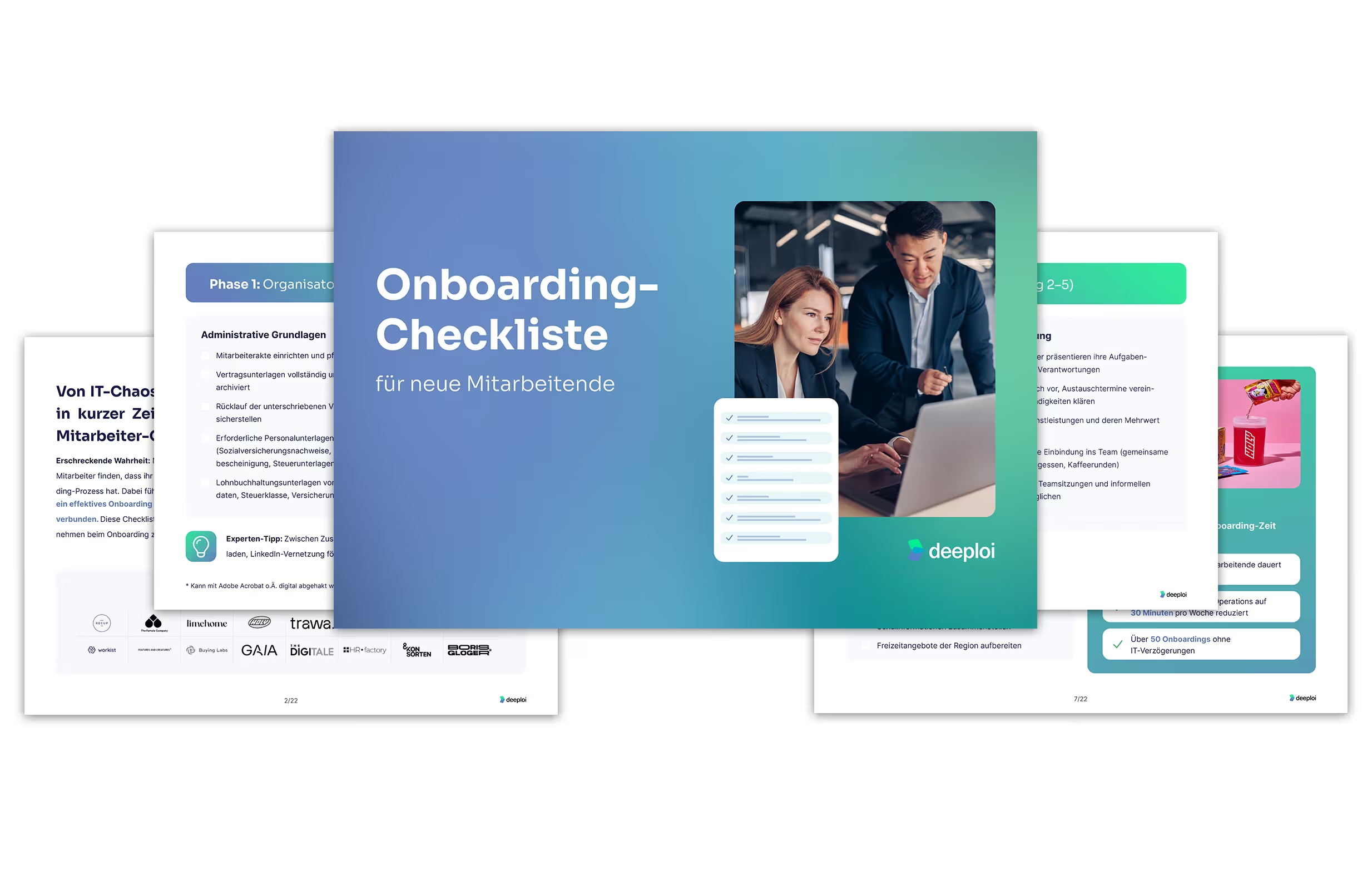
Begin with four blocks: base IT, ad platforms, analytics and tracking, and role-specific training. Then define per tool who needs access, at what permission level, and from when. For the general framework, the deeploi onboarding checklist is a solid starting point.
Can this be organised properly without an in-house IT team?
Yes – but only with clear standards. If HR or ops are covering IT on the side, you should standardise software packages, device setups, and responsibilities as much as possible. That's exactly where deeploi can help, because the all-in-one platform centralises onboarding, device management, and recurring access processes in one place.

.jpg)
.png)