








Key Takeaways
The topic at a glance
- Logistics onboarding needs more than standard checklists: New employees in warehousing, dispatch or transport operations need more than a functional induction – they also need the right access credentials, devices, safety briefings and clearly defined responsibilities.
- Safety briefings are a legal requirement: Under § 12 of the Occupational Health and Safety Act (ArbSchG) and DGUV Regulation 1, briefings must take place before work begins, must be easy to understand and must be properly documented.
- Role-based processes save time: Preparing software, hardware and tasks by role reduces chaos, eliminates waiting times on the first day and creates more efficiency during seasonal hiring.
- deeploi is the ideal onboarding solution: With automated onboarding in 3–5 minutes, predefined software packages, HR integration such as Personio and central device management, deeploi helps logistics SMEs get new employees productive quickly, safely and in a structured way.
In many logistics SMEs, onboarding still runs too manually: contracts are signed, the shift is scheduled, but on the first day WMS access, an email address, work clothing or a documented safety briefing are still missing. In warehousing, freight forwarding and transport, this immediately costs productivity and increases the risk of errors and accidents.
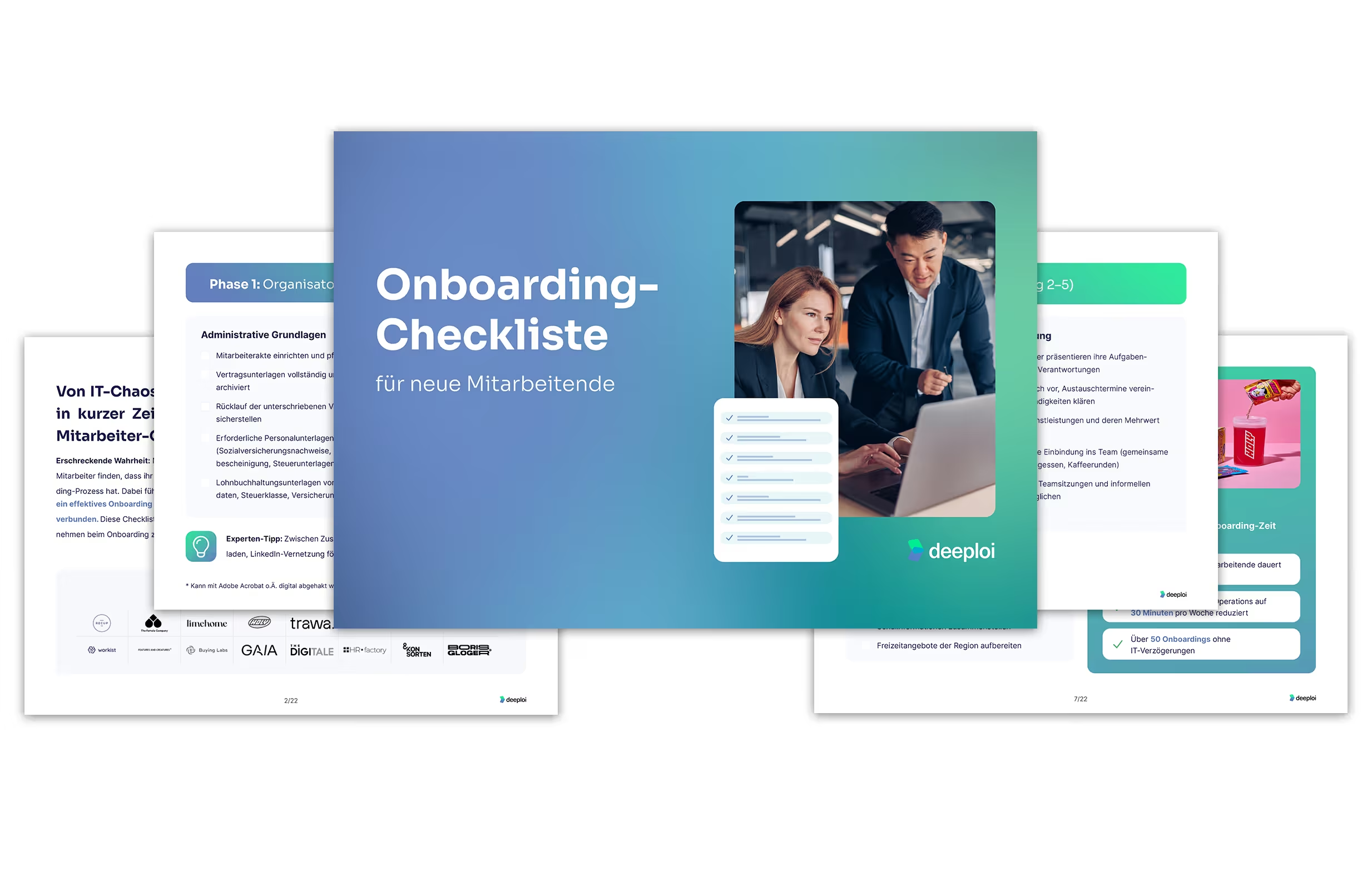
A strong onboarding checklist for new logistics employees therefore needs to bring together organisation, occupational health and safety, and IT. If you still need the general foundation, this onboarding checklist is the right starting point. This article focuses specifically on the requirements of logistics companies with commercial, operational and mobile roles.
Why onboarding in logistics requires its own rules
Onboarding in logistics is more complex than in many other industries. The reason is straightforward: you often need to organise very different working environments at the same time. New team members in dispatch typically need a laptop, email, ERP or TMS access and communication tools. New warehouse employees, on the other hand, mainly need scanners, terminal logins, a safety briefing, work clothing and a hands-on introduction directly at their workstation. Drivers also work on the move and often need to navigate driver apps, telematics or digital proof-of-delivery systems.
Add to this shift operations, seasonal peaks and a high proportion of career changers. That's exactly why a generic checklist rarely cuts it. If your company is bringing on 20 or 30 people simultaneously ahead of the Christmas rush, every step needs to be repeatable. Poor onboarding isn't just inconvenient – it's expensive: one in six employees resigns during their probationary period, often because of a weak start. In logistics, the legal dimension adds another layer: safety briefings aren't optional – they're mandatory. Starting new employees without a clear briefing on warehouse procedures, hazard zones or work equipment is not just a productivity risk; in serious cases, it can also result in fines and liability exposure.
The onboarding checklist for new logistics employees
Preboarding – from contract to day one
- Record employment contract, personal data and emergency contacts in full
- Define the role: warehouse, dispatch, driving or administration
- Prepare work clothing, PPE, ID badge, keys or access card
- Define required systems – for example WMS, TMS, ERP, email or Teams
- Assign a buddy from the same shift or location
- Schedule the safety briefing and prepare the relevant materials
On the first day
- Welcome, site tour and introductions to key contacts
- Explain the workstation, warehouse areas, break rules and reporting procedures
- Conduct the safety briefing before work begins
- Hand over devices and access credentials, test them and give a brief explanation
- Start first tasks with close supervision
In the first week
- Introduce WMS, scanners, picking processes or dispatch systems
- Explain standards for data protection, passwords and handling of customer data
- Step-by-step hands-on induction using real orders
- Plan a feedback check-in after 3 to 5 days
In the first month and probationary period
- Review progress and follow up on any outstanding access credentials or permissions
- Add specialised training for hazardous goods, forklift or fleet management only where needed
- Schedule feedback conversations at 30, 60 and 90 days
- File all documentation completely so nothing is missing in an audit
What matters here: operational and commercial roles need the same process framework, but different content. That's exactly what makes a strong logistics checklist.
IT onboarding in logistics: which systems and devices actually need to be ready
In many organisations, this is exactly where the bottleneck lies. HR communicates the start date, but IT access is set up too late, devices arrive unprepared and new employees wait for approvals. For logistics SMEs, a role-based approach is well worth the effort. Instead of rebuilding every onboarding from scratch, you define a standard package of hardware, software and permissions for each role. When you standardise your onboarding properly, chaos becomes a repeatable process with real time savings.
With deeploi, email accounts, access credentials and software can be set up automatically based on predefined packages. Combined with HR systems such as Personio, IT onboarding starts without any manual handovers via email. For standard devices, central device management ensures Windows, macOS and iOS devices are ready to company standard. Clean software licence management, automated patch management and a clear MDM strategy round out the picture.
The impact is most visible during seasonal hiring: with 30 new warehouse employees, manual IT onboarding typically takes 60–90 hours of effort. With automated processes and standard packages, that drops to around 2.5 hours. This is exactly where an all-in-one solution like deeploi demonstrates its strength.
Discuss logistics onboarding with deeploi
Documenting safety briefings in a legally compliant way
In logistics, nobody simply starts work without a briefing. Under § 12 ArbSchG, new employees must receive adequate and comprehensible instruction before beginning their duties. DGUV Regulation 1 also requires that these briefings are documented and repeated at least annually. In practice, this means: not just explaining things verbally, but recording in a verifiable way who was trained, when, and on which topics.
- Always document date, content, duration, participants and confirmation of receipt
- Conduct briefings in plain language – in multiple languages if needed
- Apply the same standard to temporary workers – the duty to provide role-specific briefings lies with the hiring company
- Keep general safety, workplace-specific risks and IT security rules clearly separate
If this documentation is missing, fines of up to €25,000 per violation can apply. More importantly: in the event of an accident or data breach, you would have no evidence that onboarding was carried out correctly.
Common mistakes in logistics onboarding – and how to avoid them
Many problems arise not from a lack of effort but from a lack of standards. In small and medium-sized logistics companies, onboarding is often split between HR, warehouse management, operations and external IT. Everyone feels responsible for only one part, and the overall process ends up with gaps.
- "Warehouse staff don't need IT onboarding": They do – quality and speed in the warehouse depend on WMS access, scanner logins and clear device processes.
- "A verbal briefing is enough": Without documentation, you're missing the most important piece of evidence if something goes wrong.
- "We only hire a few people": In small teams, every failed start is more noticeable because onboarding capacity is limited.
- "We'll sort out specialist devices on the fly": If scanners, tablets or shared devices aren't planned in advance, the first shift starts with delays.
- "We'll do IT later": Every day without access costs productivity and frustrates new employees right from the start.
A better approach is a shared standard with clear responsibilities. HR handles personal data and scheduling, managers handle induction and the buddy system, IT handles access credentials, devices and policies. Combine this with an all-in-one solution and IT workload drops by up to 95%. That's exactly why it makes sense to think of onboarding not as a single checklist, but as an end-to-end process.
Conclusion
A strong onboarding checklist for new logistics employees needs to bring three things together: a clear process, proper safety briefings and reliable IT provisioning. When roles, devices, access credentials and documentation are standardised in advance, new team members start faster, more safely and with significantly less friction.
deeploi is a strong recommendation here – you can handle on- and offboarding in 3–5 minutes instead of 2–3 hours, manage devices centrally and get support with an average response time of 12 minutes when questions arise. For logistics SMEs without a large internal IT function, this is a practical path to more efficiency, automation and time savings.
FAQ
What are the legal requirements when onboarding a new warehouse employee?
Before the first shift, you must carry out a workplace-specific safety briefing. The key legal bases are § 12 ArbSchG, DGUV Regulation 1 and – depending on the activity – additional regulations, for example covering industrial trucks or hazardous substances. What matters is not just the briefing itself, but complete documentation.
What software do new logistics employees need on their first day?
This depends heavily on the role. Warehouse staff typically need WMS access and a device login; dispatchers need TMS, ERP, email and communication tools; drivers need mobile apps and route information. The best approach is to define a fixed software package per role so nothing gets forgotten.
How do I standardise onboarding for seasonal hires?
Set up fixed role profiles, checklists and software packages. This is exactly where a solution like deeploi helps with onboarding – access credentials, email accounts and software can be set up automatically based on the role. This prevents bottlenecks when many people start at the same time.
How do I document safety briefings in a legally compliant way?
Record at a minimum: date, participants, content, duration and confirmation of attendance. It's also important that the briefing was comprehensible and relevant to the actual job. For multiple locations or shifts, a standardised form or digital process is worthwhile.
Where do I start if there's no structured checklist in place yet?
Start with four core areas: responsibilities, safety briefing, IT access and the first day. Then define the required devices and systems for each role. If you want to simplify the process in the long term, deeploi is a sensible next step for many logistics SMEs – bringing HR, IT provisioning and device management into alignment.

.jpg)
.png)