







Key Takeaways
How do you ensure that your IT infrastructure keeps pace with the rapid speed of digitalization without exceeding your budget or overloading your team? Many companies face the challenge of modernizing their IT systems while keeping day-to-day operations running smoothly. Outdated servers, insufficient security measures, and a lack of expertise can quickly become obstacles to growth. A future-proof IT infrastructure is no longer a luxury – it is the foundation of competitiveness. In this article, you will learn how to build your IT infrastructure strategically and avoid common pitfalls.
The topic at a glance
IT infrastructure forms the backbone of every modern company and includes all hardware and software components, networks, and security solutions required for smooth operations. Without a solid IT infrastructure, companies can neither work efficiently nor grow securely.
- Comprehensive components: A complete IT infrastructure combines servers, data storage, network devices, operating systems, applications, and security solutions into a cohesive overall system
- Significant time savings: Automating IT processes can save up to 95% of time – from onboarding processes and software updates to device management
- Flexibility for growth: Modern IT infrastructure enables scalability without major investments and adapts dynamically to changing business requirements
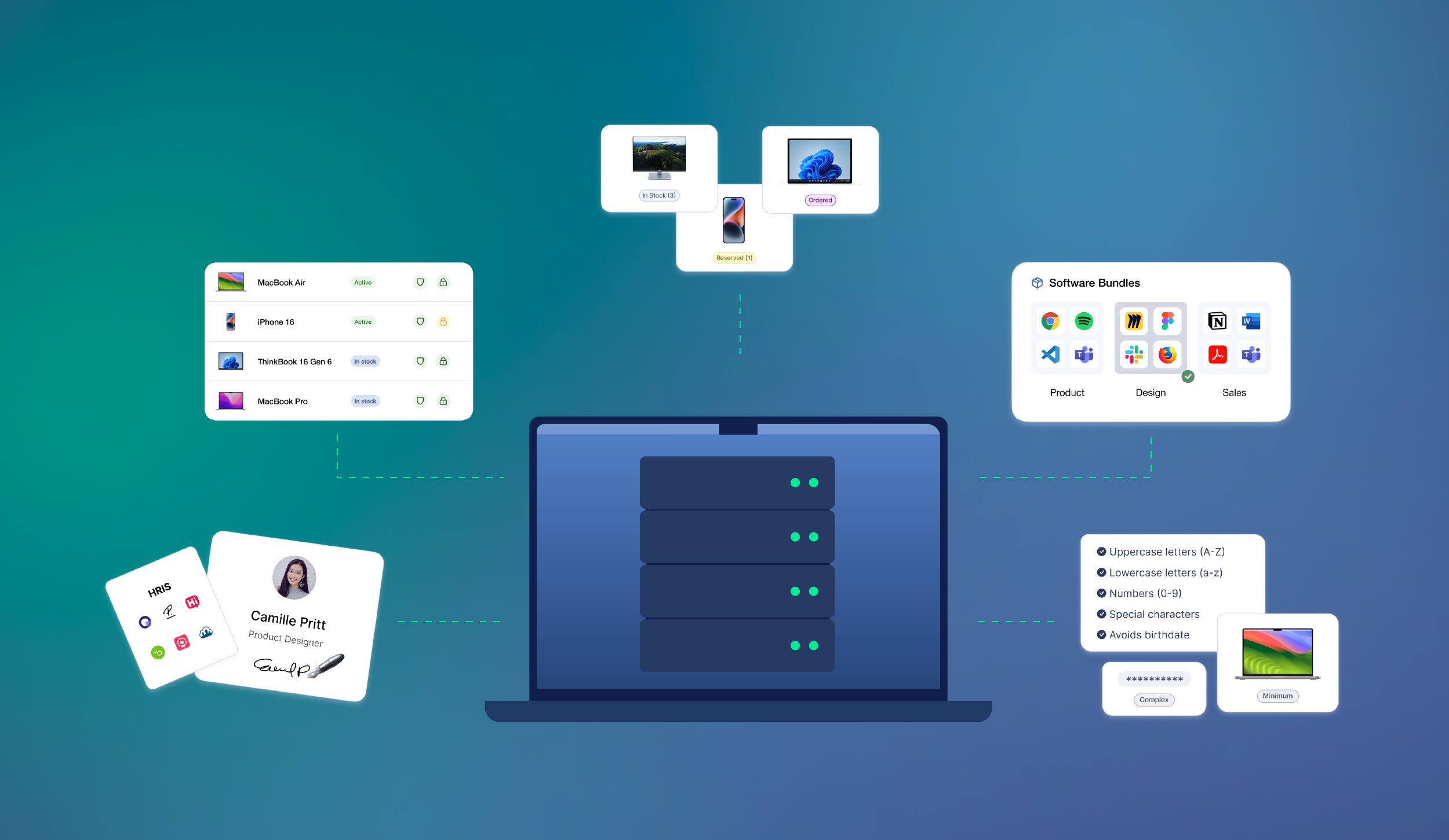
deeploi offers an all-in-one solution that relieves companies of the complexity of IT infrastructure. With automated device management, an innovative onboarding solution, and a support team that responds on average within 12 minutes, you can focus on your core business – while your IT simply works.
The two primary types of IT infrastructure
When planning your IT infrastructure, there are fundamentally two approaches to choose from: an on-premise solution, where hardware and software are operated in your own data center, and a cloud infrastructure, where resources are provided over the internet. Both models have specific characteristics that may be more or less suitable depending on your business requirements.
In practice, more and more companies rely on hybrid cloud approaches that combine the best of both worlds. Critical data and applications remain on-premise, while scalable services and less sensitive systems are moved to the cloud. This combination offers maximum flexibility and allows IT infrastructure to be modernized step by step without jeopardizing ongoing business operations.
What makes an IT infrastructure future-proof?
A future-proof IT infrastructure is defined by its ability to meet current requirements while remaining flexible enough to keep pace with technological developments and company growth. It forms the foundation for long-term competitiveness and enables companies to respond quickly to changes in the market.
- Scalability for growth: The IT infrastructure must easily adapt to increasing user numbers, growing data volumes, and new locations without requiring additional significant investments
- Flexibility for technology changes: Modern IT enables the integration of new technologies and applications without complex restructuring of existing systems
- High security standards and compliance: Automated updates, firewalls, and encryption protect against cyberattacks, while GDPR compliance and ISO certifications meet legal requirements
- Automation of routine processes: Manual tasks such as software updates, backup processes, and device provisioning run automatically and drastically reduce IT effort
- Low downtime and high availability: Redundant systems, professional monitoring, and fast support response times minimize operational disruptions
- Integration of modern technologies: Cloud services, AI-driven analytics, and modern collaboration tools can be integrated seamlessly
These characteristics are critical for business growth, as they enable efficient use of IT resources, cost control, and a high level of security at the same time. A future-proof IT infrastructure thus evolves from a cost factor into a strategic growth driver that promotes innovation instead of holding it back.
The three pillars of modern IT infrastructure
A high-performing IT infrastructure is built on three fundamental pillars that must be closely interconnected. Only when hardware and network, software and platforms, as well as security and compliance work together seamlessly does a stable foundation for digital work emerge. Each of these pillars fulfills specific tasks and contributes to the overall success of your IT environment.
Hardware & network
The physical infrastructure forms the foundation of your IT landscape. Servers provide computing power and host applications, while data storage solutions securely store your company’s data. End-user devices such as computers, laptops, smartphones, and tablets enable employees to access IT resources. The network connects all components – routers and switches ensure smooth data traffic between locations and enable real-time collaboration.
Software & platforms
Operating systems and middleware form the base on which business-critical applications run. ERP systems control business processes, CRM solutions manage customer relationships, and DMS applications organize your document management. Cloud services and virtualization enable flexible provisioning of IT resources without high investment costs. These software components turn hardware into productive tools for your business.
Security & compliance
Without comprehensive security measures, cyberattacks and data loss can jeopardize the entire business operation. Firewalls and encryption protect sensitive data from unauthorized access. Backup systems and disaster recovery ensure the availability of your IT systems even in emergency situations. GDPR compliance and ISO certifications build trust with customers and meet legal requirements for your information technology infrastructure.
Challenges in building a future-proof IT infrastructure
Many companies face significant hurdles when modernizing their IT infrastructure. Small and medium-sized businesses in particular struggle with limited resources, a lack of expertise, and the growing complexity of modern IT systems. If not addressed strategically, these challenges can quickly become obstacles to growth.
Complexity driven by technology diversity
Today’s IT landscape consists of a wide range of different systems, applications, and hardware components. Various operating systems, cloud services, on-premise servers, and mobile devices must work together seamlessly. A lack of integration between these components leads to isolated solutions that increase effort instead of reducing it. Managing this fragmented IT environment ties up valuable resources and makes it harder to automate business processes.
Budget and resource constraints
Building a modern IT infrastructure requires high upfront investments in hardware, software, and network components. In addition, there are unforeseen costs for maintenance, updates, and security measures. Many companies underestimate the financial effort required to operate their IT systems on an ongoing basis. Transparent budget planning becomes challenging when hidden costs for licenses, support, and downtime are added.
Lack of IT expertise (the “accidental IT owner” problem)
Without a dedicated IT department, IT tasks often fall to employees whose primary responsibilities lie elsewhere. These “accidental IT owners” have to manage device administration, software updates, and IT security on the side. This leads to overloaded teams, inefficient processes, and increased security risks.
{{cta}}
deeploi addresses all three challenges with an all-in-one platform designed specifically for companies without an in-house IT department. Through automation, you save up to 95% of the time spent on IT tasks. Transparent, usage-based pricing prevents unexpected costs and eliminates hidden fees. With an average support response time of 12 minutes, IT experts are available whenever you need them – without requiring you to become an IT specialist yourself.
- No in-house IT department required: deeploi takes over your entire IT management from day one and gives your team more time to focus on core tasks
- 95% time savings through automation: Onboarding in just 5 minutes, plus automated device management with software rollouts for maximum efficiency
- Transparent costs without surprises: Fixed monthly fee per employee – up to 75% more cost-effective than traditional IT service providers
- Record-fast support (Ø 12 minutes): While other providers take hours, the deeploi team resolves your IT issues quickly and efficiently
- All-in-one instead of chaos: One platform for devices, software, security, and support – no more juggling multiple tools and vendors
Practical steps to modernize your IT infrastructure
Modernizing your IT infrastructure does not have to be an overwhelming project. With a structured approach, you can build a future-proof IT environment step by step without disrupting ongoing operations. The following steps help you tackle the modernization process systematically and avoid common mistakes.
- Assess your current state: Analyze your existing IT infrastructure systematically. Which hardware and software are in use, where are the weaknesses, and which systems require the most maintenance?
- Define requirements: Align your business goals with IT needs and define clear requirements for scalability, security, and availability of your IT resources
- Set priorities: Address critical areas first. Servers with frequent downtime, outdated security solutions, or inefficient manual processes should take precedence
- Migrate step by step: Minimize risk through phased implementation instead of a single large transition. Test new components alongside existing systems
- Implement automation: Reduce manual work through automated workflows for onboarding, software updates, and device management
- Establish monitoring: Implement continuous monitoring and optimization to detect issues early and improve the performance of your IT infrastructure
With deeploi, the process of modernizing your IT operations becomes faster and easier. Our team supports you with best practices and ensures a smooth transition. On our platform, you have full visibility into your devices, onboarding processes, and IT security status. Ordering new devices, onboarding employees, updating software, and enforcing security measures becomes up to 95% faster.
Conclusion: how to build a future-proof IT infrastructure
A future-proof IT infrastructure is now the decisive competitive advantage for companies that want to grow efficiently. The right combination of hardware and software, well-designed network components, and professional security solutions creates the foundation for digital business processes. Automation is the key to efficiency – it reduces IT effort by up to 95% and relieves your team from time-consuming manual tasks.
The success of modern infrastructure solutions depends largely on having the right expertise. Without in-depth knowledge in planning, implementation, and operations, companies risk costly misinvestments, security gaps, and inefficient processes.
deeploi is an all-in-one platform for companies that want to modernize their IT infrastructure without having to build an in-house IT department. More than 150 satisfied customers already trust our solutions, which cover everything from device management and software provisioning to fast support.
FAQ – frequently asked questions about IT infrastructure solutions
What does a perfect IT infrastructure look like, and why do I need an expert to implement it?
There is no such thing as a perfect IT infrastructure – it must fit your individual business requirements. The right combination of hardware, software, and security requires in-depth expertise, as integrating different components is complex. Experts like deeploi ensure scalability and future readiness by providing professional IT infrastructure solutions and aligning all elements optimally.
How can I tell if my IT infrastructure is outdated?
Common warning signs of outdated IT systems include frequent server outages, slow data processing, known security vulnerabilities without available patches, and a lack of scalability as the business grows. High manual effort for software updates, difficulties integrating new applications, and rising maintenance costs also indicate the need for modernization. If your team spends more time dealing with IT issues than on productive work, it is time to act.
How can I modernize my IT infrastructure without operational disruptions?
A phased migration is the key to disruption-free modernization. Run new and existing systems in parallel until all components have been tested. Careful planning with clear timelines and rollback options minimizes risk. With deeploi, you do not need to worry about this – we take care of it for you.
What is included in a complete IT infrastructure solution?
A complete IT infrastructure includes hardware such as servers and end-user devices, software including operating systems and applications, a secure network with routers and firewalls, comprehensive security solutions, professional support, continuous monitoring, and reliable backup systems.